
Published: August 23, 2026 | Updated: August 23, 2026
An accessible bathroom in Dallas costs $12,000 to $45,000 in 2026, depending on how much you change and whether the work touches your slab. A curbless shower and grab bars sit at the low end. A full layout change with a widened doorway and a roll-in shower sits at the top. The single biggest cost driver here is one most homeowners never think about: the post-tension slab under most Dallas homes built after 1980.
So this guide covers what an accessible bathroom actually means, where ADA specs and aging-in-place design differ, real 2026 DFW costs, and the local conditions that change your number. We are a referral service — we match you with vetted Dallas contractors who do this work — so the advice here is the honest picture, not a sales pitch.
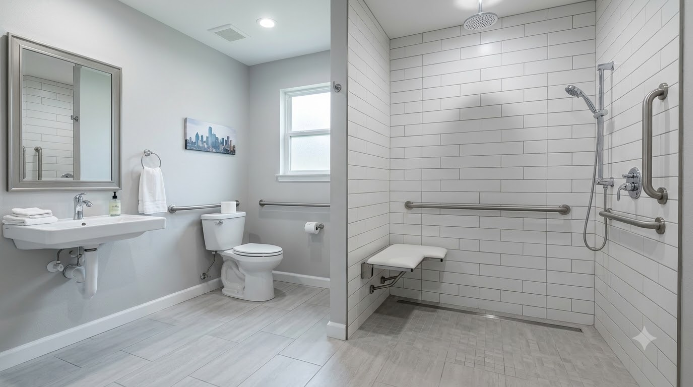
What counts as an accessible bathroom in Dallas?
An accessible bathroom is one a person with limited mobility can use safely and independently. That means room to move, no trip hazards, support where weight shifts, and fixtures at reachable heights. It is not one fixed template. What a wheelchair user needs differs from what a homeowner planning to age in place needs.
Two standards get mixed up constantly, so start here. ADA (Americans with Disabilities Act) sets specs for public and commercial buildings. Your private home does not have to meet ADA. Aging-in-place design borrows the useful parts of ADA and adapts them for real homes and real budgets.
Why does this matter for your wallet? Because chasing full ADA compliance in a house you own is often overkill. You pay for clearances and specs a private home never needs. Therefore the smarter move for most Dallas homeowners is an accessible bathroom designed around aging-in-place principles — one that uses ADA as a reference, not a rulebook.
ADA specs vs. aging-in-place: where they diverge
Both approaches share a core goal: safe, independent use. However, they part ways on how strict the numbers are. So here is where the difference shows up in a real remodel.
| Feature | ADA reference spec | Aging-in-place (home) |
|---|---|---|
| Doorway clear width | 32 in. minimum | 32-36 in. — wider is easier for walkers |
| Turning space | 60 in. circle for wheelchairs | Nice to have; often not feasible in older homes |
| Grab bars | Rated to 250+ lb, set heights | Same rating; placed to the user, not a chart |
| Shower entry | Curbless, roll-in | Curbless preferred; low-curb acceptable |
| Toilet height | 17-19 in. seat | Comfort-height (17-19 in.) — same idea |
Notice the pattern. The rating on a grab bar is non-negotiable in both columns — it either holds a falling adult or it does not. But the 60-inch turning circle is where home budgets and ADA part company. Most Dallas bathrooms cannot fit one without stealing space from a closet or bedroom, and that turns a $15,000 project into a $35,000 one fast.
The one spec you should never compromise
Grab bar anchoring. For example, a towel bar screwed into drywall pulls out under load. But a real grab bar mounts into blocking — solid wood behind the wall — or into studs, so it holds 250 pounds or more. Therefore, if a contractor offers to “just add bars” without opening the wall for blocking, that is the warning sign. Walk it back and ask how they are anchoring them.
What an accessible bathroom costs in Dallas (2026)
Accessibility work layers on top of a normal bathroom remodel. So start from the base ranges and add from there. In the DFW market in 2026, a guest or secondary bath runs $8,000-$18,000. Mid-range full baths run $18,000-$35,000. At the top, a luxury or master spa runs $40,000-$75,000+. Because accessibility features add labor and specialized fixtures, they push you toward the upper half of whichever range fits your bathroom.
Here is what the specific upgrades add on their own:
| Accessibility upgrade | Added cost (DFW 2026) |
|---|---|
| Grab bars, professionally anchored (set of 3) | $300-$900 |
| Comfort-height toilet | $400-$1,200 |
| Curbless / roll-in shower conversion | $6,000-$15,000 |
| Widening a doorway to 32-36 in. | $1,500-$4,000 |
| Slab work for drain relocation (post-tension) | $2,000-$5,000+ |
| Full layout change for turning space | $10,000-$25,000+ |
The curbless shower is where most of the money and most of the risk live. To drain a floor with no curb, the floor has to slope to the drain — which usually means cutting into the slab and re-setting the drain. On a slab-on-grade home that is routine. On a post-tension slab, it is a specialist job. For the full breakdown of how Dallas contractor pricing works, see our Dallas contractor cost guide.
The Dallas slab problem nobody warns you about
Most Dallas homes built after 1980 sit on a post-tension slab. That is a concrete slab with steel cables running through it under tension. Cut one of those cables during a drain relocation and you have a structural repair, not a plumbing job. This is the detail that separates a Dallas accessibility remodel from a generic national how-to.
So before you commit to a curbless shower, your contractor needs to locate the cables and plan the drain around them. That step alone drives the cost difference. As a result, a roll-in shower in a post-1980 Dallas home costs more than the same shower in an older Lakewood or M Streets house on a conventional slab.
Older East Dallas and Oak Cliff homes bring the opposite trade-off. The slab is easier to work, but you often hit galvanized plumbing and pre-1980 wiring behind the walls. Either way, the surprise in an accessible bathroom Dallas project is in the structure, not the tile. So budget a 10-15% contingency and you will not get blindsided.
Do you need a permit for an accessible bathroom?
Yes, for almost any accessibility remodel worth doing. Moving a drain, relocating the toilet, or changing electrical all require a permit from the City of Dallas Development Services Department. Widening a doorway in a load-bearing wall does too. However, swapping a toilet or adding grab bars to existing blocking does not.
The gray area is the doorway. Widening it is simple if the wall is non-load-bearing. If it is load-bearing, you need an engineer’s assessment and the permit gets more involved. Your contractor should know which wall is which before quoting — if they shrug at that question, keep looking. You can verify permit requirements directly through the City of Dallas Development Services office.
Aging in place: design for the next 20 years, not today
If you are remodeling to stay in your home as you age, the common mistake is designing for how you move now. Instead, design for how you will move at 80. That does not mean a clinical, hospital-looking bathroom. Because good aging-in-place design is invisible until you need it, it can look every bit as sharp as any other remodel.
Take the curbless shower. It reads as modern and high-end, but it also happens to be wheelchair-ready. Because blocking in the walls costs almost nothing during a remodel, put it in even if you do not need bars yet. Adding it later means opening finished walls again. Lever handles, a handheld shower, and a comfort-height toilet round it out — they look normal and work better for everyone in the house.
Here is the honest advice we would give a friend. If you are already gutting the bathroom, add wall blocking everywhere a bar might ever go. It costs a few hundred dollars now. It is the cheapest insurance in the whole project. And skipping it is the regret we hear most.
Accessible bathroom Dallas: how your neighborhood changes the plan
Where you live in Dallas shifts both the cost and the approach. An accessible bathroom in Highland Park or University Park runs 15-25% higher than the same job elsewhere. Partly that is pricier finishes. But it is also HOA architectural review, which can add two to four weeks. So if your project touches anything visible from outside, budget the time.
In East Dallas, Lakewood, and Oak Cliff, the homes are older and the slab is usually conventional, which makes a curbless shower easier to drain. However, those same pre-1980 homes hide galvanized plumbing and undersized electrical panels. Therefore an accessibility remodel in these neighborhoods often turns into a plumbing-and-electrical update too — plan for it rather than being surprised by it.
Frisco, Plano, and McKinney homes are newer, so the post-tension slab issue applies in full. Moreover, contractors who do this work well book out four to eight weeks in those suburbs. In short, an accessible bathroom Dallas project is never just about the bathroom — the year your home was built matters as much as the fixtures you pick.
How to choose a Dallas contractor for accessibility work
Not every remodeler does this well. Specifically, accessibility work needs someone who understands slab structure, grab-bar anchoring, and waterproofing a curbless floor. Those are three things a general kitchen-and-bath crew may not have done often. So ask to see a curbless shower they built and how they handled the drain slope.
Ask two specific questions. First: “How do you anchor grab bars?” The right answer mentions blocking or studs and a weight rating. Second: “What kind of slab is my house on, and how does that change the plan?” A contractor who knows Dallas will answer both without hesitating. For the full vetting process, read our guide on how to hire a general contractor in Dallas.
Ready to plan an accessible bathroom? We match Dallas homeowners with vetted, licensed, insured independent contractors who specialize in accessibility and aging-in-place work — free to you, no obligation. Compare our Dallas bathroom remodeling matches or call (432) 217-9260.
Frequently asked questions
How much does an accessible bathroom cost in Dallas?
In the DFW market in 2026, expect $12,000 to $45,000. A grab-bar-and-curbless-shower update lands near the bottom. At the top sits a full layout change with a widened doorway and slab work. Note too that a post-tension slab adds $2,000-$5,000 when the drain has to move.
Does a home bathroom have to meet ADA standards?
No. ADA applies to public and commercial buildings, not private homes. Most Dallas homeowners use aging-in-place design instead, which borrows the useful ADA specs — like curbless entry and rated grab bars — without the strict clearances a home rarely needs.
Can you add a curbless shower to any Dallas home?
Almost always, but the cost depends on your slab. On an older conventional slab it is routine. On a post-tension slab common in post-1980 homes, the drain relocation is a specialist job and costs more. Your contractor should locate the cables before quoting.
Do I need a permit to make my bathroom accessible?
For most real accessibility work, yes. Moving a drain, relocating the toilet, or widening a doorway needs a City of Dallas permit. Adding grab bars to existing blocking or swapping a toilet does not. Widening a load-bearing wall also needs an engineer’s sign-off.
What is the most important accessibility feature to get right?
Grab bar anchoring. A bar mounted into drywall alone will pull out under a person’s weight. It has to anchor into blocking or studs and hold 250 pounds or more. If a contractor skips opening the wall for blocking, that is a warning sign.
Related reading
